Author Archives: Cplummer

Lambertville Tree Clearing Update—Coryell to Bridge, and South

March 26, 2019

In previous correspondence,  NJWSA stated they would,

“Thin-out the underbrush and small trees on the western bank and in and on the stone wall between Coryell Street and Bridge Street.”
In fact nearly every tree between Coryell and Bridge has been eliminated, and if not for citizen and mayoral intervention, the large tree near the Bridge Street bridge would have been removed. (Photos forthcoming, details below).
From: Judy Detrano
Date: March 23, 2019 at 9:53:57 PM EDT
To: Christopher Plummer, Julia Fahl
Subject: Re: Trees along the canal (info now on my blog)

Hi Chris,

I have but a bit more information which I will email you tomorrow.  I was with them as they cut away and with the help of Mayor Julia and Cindy Ege we saved the tree by the canal at the bridge alongside the Princeton Bank.   Michael A. Sellar was the Facility Manager , Delaware & Raritan Canal Office, that I spoke with on site.  <snip> The destruction of our trees in and around Lambertville has become an issue to be addressed and we need the support of a number of departments, including NJ DEP.


March 25, 2019

Hello again Chris,

FYI…
Upon speaking with Michael Sellar of the NJWSA on-site the day they cut down the trees from Coryell to Bridge Street in Lambertville the following answers to my questions were as follows:
1.  The cutting of the trees was to prevent them from falling into the canal which would undermine the drinking quality of the water
2.  They believe the trees and shrubs are destroying the structure of the stone wall along the canal, river side of the canal
3.  They are not fixing, replacing or relining the stone canal wall (even though the stones are there in the canal) because the budget allotment  does not cover the expense to do so.  It is faster, easier & cheaper to cut down the trees.
4.  He has no explanation for why a tree here and there was left uncut but they would be happy to come back and cut them down.  (3 trees remain by the River Horse Brewery building)
5.  He is not aware of any advance notice required to the city of Lambertville as that side of the canal falls under their maintenance obligations.
6.  The towpath side of the canal will not be sheared by them as that side of the canal is under the authority of NJ State Parks Commission.
7.  They admit that their maintenance of the canal has been neglected for close to 25 years due to budget constrictions
8.  They can be stymied by the Shade Tree Commission from cutting down a tree that falls under the Shade Tree protection.
+The NJWSA supposedly has a Capital Fund Component for Capital Improvement..where is that money and why not fix the stone wall
+They are indeed required to notify the public if more than 1/2 acre is to be ‘deforested’ with 60 days to hold a public hearing
+ I have not ascertained their responsibility to notify the City of Lambertville
+ They might have had to submit a tree cutting plan to the Division of Parks & Forestry as the property is also NJState Park property. (or should have)
+ It may be possible to demand some sort of replanting to refurbish the embankment via the Delaware & Raritan Canal Commission
+ There were no Project Updates or notices on the NJWSA website referring to Lambertville that I uncovered
+ There appears to be no coordination/integration/communication between the various commissions to control either of  committees/authority/commssions to review, supervise or hold to any aesthetics of proposed work, nor review of the destruction of wildlife habitats, particularly to bird species and bats.
+ If the DRCC has jurisdiction over the entire state-owned D & R Canal, should they have not been notified and required to offer approvals of the NJWSA ?
+ Also, where would a public notice appear that would reach the residents of Lambertville without their needing to search for such a notice.
+ And, I have heard, with no further information, explanations or confirmations, that the railroad had leased the property to which the rails are on, but that their lease had/has expired and there is no current enforceable lease at this time.  Does that not restrict them from doing anything along the tracks through Lambertville until that is made more clear and current in their authority to do so.  AND that the railroad does impact our wildlife habitats, noise and air pollution…..and what input do the residents of Lambertville have, if any, to curtail their work in our city.
Regards,
Judy Detrano


Concerned citizens are encouraged to contact their representatives:


The City of Lambertville
Mayor Julia Fahl
City Hall
18 York Street
Lambertville, NJ  08530
Telephone:  609.397.0110
 “Ask the Mayor”


John Hutchison
Executive Director
Delaware & Raritan Canal Commission
609-397-2000

John.hutchison@dep.nj.gov


Clinton Administration Building
1851 State Route 31
P.O. Box 5196
Clinton, NJ 08809
P: (908) 638-6121
F: (908) 638-5241

info@njwsa.org


Patricia Kallesser
Park Superintendent
145 Mapleton Road
Princeton, NJ 08540
Phone: 609.924.5705

Peace Out
— Christo

Ready or Not

Friday, March 15, 2019
Work continues on clearing the rails for the Lambertville Tourist Train. No estimates on actual arrival of an engine with cars. Maybe they want to have one on display in time for Shad Fest? But maybe the crumbling canal walls and collapsing roadbed should be shored up first?


“You call it progress. I call it destruction.”— Comment of an anonymous five-year-old on watching the take-down of large tree.


 “They took all the trees and put ’em in a tree museum…”

—🚕 “Big Yellow Taxi“, Joni Mitchell

PEACE OUT

— Christo

Wake up and smell the 5G — Not for me!


back1

Wednesday May 8, 2019— Some new links…

1) The EHT “Fact Sheet” —Better than the printed version because all the links in the PDF are live.
2) The “Sample Code” for small city ordinances (the PDF is helpful for copy/paste if actually crafting an ordinance)
3) “Generation Zapped”— the movie I would like to get the Lambertville ACME to show.
4) “The Terrifying Potential of the 5G Network”, by Sue Halpern, in The New Yorker, April 26, 2019, recent article recommended by a #StopPennEast associate—

April 2, 2019 —Update: Verizon wants Lambertville to be a “Smart City”. Want to be smart? Learn about 5G! Lots of great information from the Environmental Health Trust.  Keep it simple, and start here:


Saturday, April 20, 2019Update: Thank you to Nancy Kay Anderson for sending me an informative fact-based link from Physicians for Safe Technology, about Wireless Technology and Public Health“.

— Christo


March 12, 2019 — My first pass at summarizing 5G…do we really want this hazardous electronic junk cluttering the streets of our quaint, historic city???

Verizon, Verizon, put away your new 5G.
No more cell towers, just leave me the birds and bees, please!

At the March 5 working session in Lambertville, I asked Mayor Julia Fahl if she had any information about the possible health threats of the 5G technology promoted by Verizon. Verizon claims “Right of Way” to add Cell Tower electronics to an unknown number of existing telephone poles in Lambertville. I gathered the information on this page for the Mayor. To avoid the conspiracy theories and extreme ideas that plague the internet, I sought information that is:

  • About 5G (as opposed to just cellular or cell phone)
  • Current
  • Fact-based (with sources),
  • Covers the efforts by industry (telecom companies) to aggressively “roll it out”.

If you only look at one thing, please watch the first 10 minutes of the video below!

Washington DC Council 5G Small Cell Roundtable
https://youtu.be/ljLynbr5iPc <—Watch the first 10 minutes. (After other speakers, Mr. Motus speaks a bit more at the end.)

Physicians for safe technology – A good written summary which contains many additional sources. There are several studies about adverse health effects of MMW (millimeter wave-length) as well as cellular (microwave) radiation established as carcinogenic.
https://mdsafetech.org/5g-telecommunications-science/

Environmental Damage— Insects, birds, other wildlife at risk? Don’t miss (or be put off by the title of) the “Insect Armageddon” 7 minute video, referred to, and with sources in the link above.
https://youtu.be/zwo2E9b9CiU

The Industry hard push for legislation to ensure adoption—“Verizon, AT&T and other wireless providers have pushed such legislation here (in California) and elsewhere to ease deployment of so-called small-cell equipment that boosts coverage provided by larger cell towers, particularly in urban areas and in anticipation of fifth-generation (5G) network technology. The bill would have granted the companies rights similar to those of utilities, leaving local governments with limited power to set fees or restrict placement on streetlights and traffic signal poles.”
http://www.sfchronicle.com/opinion/editorials/article/Editorial-Gov-Brown-right-to-block-industry-12282623.php

According to Mr. Mottus (from the video, above) the National League of Cities and League of Mayors are opposed to “small cell rollout” which is promoted nationally in U.S. S3157 . <—Click here to check status and read the bill.

At time of writing, S3157 is “in committee” with U.S. Senate “Commerce, Science, and Transportation Committee”.  In one committee hearing, Senator Blumenthal asks industry representatives about Health Risks:
https://youtu.be/ekNC0J3xx1w

The push by industry is happening globally. Similar discussions are occurring in Canada…
Canadian Senate Bill 637—Senator Patrick Colbeck Testifies Against 5G: Hearing 2018
https://youtu.be/j-UEuOYOED4

Despite the 5G hype, there is no clear need for it:
“What can 5G do that other systems can’t? This is where there is no clear answer,” said Hemant Minocha, EVP for device and IoT at TEOCO. There is no 5G requirement for IoT [Internet of Things], he points out, and the business case hasn’t yet been proven out for ultra-low latency (not to  mention that LTE is capable of lower latency than it has achieved to this point in networks).”
https://www.saferemr.com/2017/11/5g-wireless-technology-cutting-through.html

How many towers are we talking about?
“While early work estimated that as many as 40 to 50 homes could be covered by a single fixed wireless site, according to Rouault of EXFO, that number has turned out to be around five in testing because of the complexity of beamforming necessary to support multiple homes.”
https://www.saferemr.com/2017/11/5g-wireless-technology-cutting-through.html

What do the towers look like?
“Mystreetmychoice” is a web site in opposition to the 5G roll out in California, see the photos on their home page.
http://mystreetmychoice.com/index.html

Rarely mentioned, Data Security risk— “5G has 200 times more access points for hackers than existing networks, experts warn”, Financial Post
https://business.financialpost.com/telecom/attack-surface-has-multiplied-5g-networks-more-vulnerable-to-hackers-conference-told

Some additional links:

Scientists and Doctors Demand Moratorium on 5G

5G Wireless Technology: Is 5G Harmful to Our Health?

5G Wireless Technology: Millimeter Wave Health Effects

5G Wireless Technology: Newspaper editorials oppose “small cell” antenna bills

Cell Tower Health Effects

International EMF Scientist Appeal

An Exposé of the FCC: An Agency Captured by the Industries it Regulates

FCC: Why We Need Stronger Cell Phone Radiation Regulations–Key Testimony

Cell Tower Radiation Affects Wildlife: Dept. of Interior Attacks FCC


PEACE OUT,

—Christo

Tree Stump Gallery #1

Photos of Delaware Canal Tree Clearing in Lambertville, New Jersey 2018-2019

“Don’t it always seem to go, that you don’t know what you’ve got till it’s gone?”
— 🚕 “
Big Yellow Taxi“, Joni Mitchell


This slideshow requires JavaScript.


No, this has nothing to do with the “Emerald Ash Borer”. For information about this Tree and Brush Clearing Project go here.


Tree Stump Gallery #1 — 53 Photos


Peace Out…

— Christo

Authorities say Canal-side Brush and Tree Clearing in Lambertville is NOT for the Railroad, but…

Tree Stumps and Survivor Guilt on the Canal Path-011🚂 Looks Like, But is Not the Railroad—In a short section of the Delaware and Raritan Canal in Lambertville, between Coryell Street and the empty River Horse Brewery, sixty to one hundred trees, some apparently close to fifty years old, were converted to wood chips and sawdust in a matter of days. Was this part of the initiative to preemptively strike at the Emerald Ash Borer beetle? Nope, most of those trees were felled already, their trunks can be seen lining the canal path between Lambertville and FrenchTown.

And it wasn’t just the trees—shrubs, vines, weeds, saplings, and pretty much any other living thing was scraped clean from the railroad tracks to the canal bank (See photos.) So what was this all about?

Ask just about anyone in Lambertville familiar with the situation and they’ll tell you, “It’s the railroad!” To many surprised residents the recent tree and brush clearing appeared to be an effort to clear the overgrown and unused railroad tracks for the “Tourist Train” proposed by Black River and Western Railroad. BRWR hopes to run on weekends behind Clinton Street, over the “Nifti” Bridge behind Rojo’s Roastery and the Roxy Ballet Studio, passing over Alexauken Creek and proceeding to Ringoes and Flemington and back.

Despite appearances, according to several authorities, officially, the clearing work is unrelated to the railroad.

Why so much confusion? No signs, no notices—Work began abruptly in December of 2018 with no apparent advance notice provided to residents or local businesses, nor to the officials of the City of Lambertville. No signs were posted on the canal path. Similar work had been performed some years ago closer to Bridge Street, but the recent work was more “thorough”— or drastic, depending on your perspective—this time only a few trees were allowed to remain.

Concerned citizens contacted Lambertville City authorities, discovered that they had no information about the project, and were referred to the Delaware & Raritan Canal Commission.

Delaware & Raritan Canal Commission Executive Director, John Hutchison, explained “the project is being undertaken by the NJ Water Supply Authority pursuant to the 1986 lease agreement with the State” for the purpose of clearing the canal and maintaining the water flow. He explained, “Jurisdiction over the D&R Canal is somewhat complex…”

“I hope this information is useful.  If you have any questions, please do not hesitate to contact me.  Also, the Commission meets monthly to review project applications and our meetings always include a public comment portion.  The Commission meets the third Wednesday of the month at 10:00 a.m. in the Prallsville Mill Complex in Stockton.” — John Hutchison, Executive Director D&R Canal Commission


D&R Canal State Park Superintendent Patricia Kallesser met one Lambertville resident and explained that this ongoing work of the NJWSA had to do with maintaining the water flow in the canal and upkeep of the historical (stone wall) structures. When asked about the lack of communication, she explained that the NJWSA web site maintained a FAQ about it on their web site.


The New Jersey Water Supply Authority at this writing does not list the Lambertville work on its “Public Notices”, but it is explained on their “Maintenance Along the D&R Canal FAQ”.

I emailed the NJWSA (to the “Info” mailbox, as no name was available on the site):

From: Christopher Plummer
Sent: Tuesday, January 1, 2019 10:54 AM
To: info
Subject: Please consider local interests w/Canal Brush and Tree Clearing in and around Lambertville

Dear NJ Water Services Authority,

I, and other residents, merchants, and “canal walkers” were very surprised by the recent clearing of over 100 trees, some large, 20-30 years old, and the “buzz cutting” of brush and shrubs from the railroad tracks to the edge of the canal starting near Finkel’s Hardware on Coryell Street and moving North on the West side of the canal. This work adversely impacted:

  • Bird and animal life and habitat prized by many residents, businesses, and tourists.
  • Local Visual aesthetics, exposing parking lots and warehouses that were screened by foliage, leaving a trail of tree stumps and giving that section of the canal an industrial appearance that had previously been “natural”.
  • Noise – the elimination of trees and shrubs that provided an acoustic buffer to the noise from the river recreation, roads, and New Hope.

<snip>

May I suggest in the future:

  1. Inform the public with accurate information about the purpose, scope, schedule, and likely impact of the work by posting signs on the canal path and in local papers, and phone calls to local officials.
  2. Provide time and a means for those concerned to give feedback before the work is started.
  3. Please give some weight and consideration to those concerns and find a balance between the preservation of historical structures and the preservation of current flora and wildlife habitat.

Thank you for your consideration, and best wishes for the New Year.

Sincerely,

Christopher Plummer

The NJWSA provided a response (below) to my query:
From: info <info@njwsa.org>
Subject: RE: Please consider local interests w/Canal Brush and Tree Clearing in and around Lambertville
Date: January 18, 2019 at 11:24:00 AM EST
To: ‘Christopher Plummer’
Dear Mr. Plummer,

Thank you for your concerned email and our apologies for the delay in response.  And thank you for your suggestions on future public notification, which we will certainly take under advisement.

As you know, the Authority’s mission is to maintain a flow of water through the Canal to provide raw water supply for our customers.  Our Canal maintenance crews and engineers need to “see” the embankment.  Seeing the embankment often helps us to prevent damage to the embankment that may develop from tree roots or animal burrows which can lead to seepage paths or from damage when the trees fall and their root balls remove sections of the embankment.  The Authority’s needs to see the embankment are constantly balanced with the wants and needs of Canal park walkers, joggers, bikers, nature enthusiasts, fishermen, historians, neighbors, and others [My emphasis—Christo] , all of whom may have a different idea of what maintenance should look like on the 60 plus mile Canal.   We tried to provide an understanding of our work in the FAQ’s that were recently posted on the website.


For the upcoming winter work on the Canal in Lambertville, crews may begin again as early as the week of January 21, 2019.  The exact schedule for the winter maintenance is weather dependent, and subject to equipment and personnel availability, and will include the following (in no particular order):
  1. Thin-out the underbrush and small trees on the western bank and in and on the stone wall between Coryell Street and Bridge Street.
  2. Clearing the vegetation from the Lambertville lock walls.
  3. Felling three Ash trees from the east side of the Canal, upstream of the Lambertville Lock.
  4. Removing the trees growing from the stone wall, on the river side of the embankment, from the wing dam (in the River) and downstream.
Items #1 thru #3 should only take several days each and should be completed this winter.
Item #4 will take quite a bit of time and will most likely occur over several years depending on other emergent items that need to be addressed and may stop and restart within the same year.
Feel free to share this information with other concerned residents.
(No sender name identified)

I Guess that was the Public Notice. I forwarded a copy to the City of Lambertville. I haven’t seen any new notices or additional information about the canal work. Have you? The NJWSA is apparently continuing their work up the south end of town as described in the email.

Local railroad supporters on Facebook are urging residents not to “listen to rumors” and espousing the wonders of bringing the iron horse, full of tourists, to Lambertville to reinvigorate our little town.

🚂 Meanwhile if it quacks like a duck…  At the North end of town small crews and individuals with mowers and chainsaws are clearing the railroad tracks. They make no pretense about working for the Water Authority.

Feb. 26, 2019 Tuesday – Today NJWRA trucks and teams are clearing the rails and canal, between Coryell and Bridge, chipping as they go.

Eagles check nesting options
—By the way, the empty nest this late in the season suggests that Bald Eagles will not be nesting on the power tower over Alexauken Creek this year. In 2017 they raised three fledglings at the site, not far from the “Nifti” Railroad Bridge and abandoned rail car at the north end of the trail in Lambertville.


Residents who wish to communicate their concerns about the destruction of wildlife habitat, the need for trees and brush as a visual screen and natural noise buffer, and other concerns are urged to contact any or all of the individuals and organizations below:


The City of Lambertville
Mayor Julia Fahl
City Hall
18 York Street
Lambertville, NJ  08530
Telephone:  609.397.0110
 “Ask the Mayor”


John Hutchison
Executive Director
Delaware & Raritan Canal Commission
609-397-2000

John.hutchison@dep.nj.gov


Clinton Administration Building
1851 State Route 31
P.O. Box 5196
Clinton, NJ 08809
P: (908) 638-6121
F: (908) 638-5241

info@njwsa.org


Patricia Kallesser 
Park Superintendent 
145 Mapleton Road
Princeton, NJ 08540
Phone: 609.924.5705

Peace Out
— Christo

After Montmartre

🇫🇷 The Great France Art Tour of 2017

France 2017-0037 – Version 2

There are times when I feel I have a pretty good handle on where I am in Paris and others when I admit that I have no clue. It’s the places in-between that prove the most difficult. Where I am neither confident that I know, but believe I have some vague idea that can’t be too far off, but which may ultimately prove to be delusional. The afternoon of our longest day was like that.

The afternoon was waning when we found a Metro stop at the bottom of the mont. We popped out as intended on the Left Bank at St. Germain Des Pres. Here Boulevard St. Germain skirts along a few blocks from the Seine. We walked North in search of a café or bistro where we could catch a late lunch.

I had on a previous trip explored the Boulevard St. Germain for a few blocks behind Musée D’Orsay, and found the area a delight—full of small cheese shops, patisseries, and such. I also harbored the vague notion that many of the famous cafés were either nearby or situated on Boulevard St. Germain. Early that same morning, while still on our coach, we had zoomed past one of these “famous” cafes, the ones mentioned too frequently in Hemingway’s “A Moveable Feast”. Was it the La Closerie d’Lilas? Or Les Deux Magots? Or some other? Who knows? Honestly, I don’t. (By the way, the Magots? What a name. What does it mean? It means, “The two stocky figures from the Far East“. I know. Weird. It’s about these two statues that are still inside. You read about it.) I read about them, I flash by in a bus, and of course I think, “Cool! Wouldn’t it be great to sit there where Hemingway did, watching while some minor literary acquaintance blithely and foolishly cuts Aleister Crowley, ‘the most evil diabolist in all of Paris’.” Well, maybe. But the guidebooks say these places are overpriced due to their fascinating histories, not for the quality of their fare. And in the end, it’s never the right time or convenient situation to sit “there”, and so I settle for something or somewhere else.

My memories of Paris when I first visited as a teen are so dim. I wish I had written a journal of that trip! Blogs didn’t exist then. Nor did personal computers or cell phones. It would have been a paper journal. Nevertheless, some images remain—old ladies sweeping the sidewalks of the Champs’d’Elyses with wooden brooms the brush ends of which consisted of tightly bound twigs. Men stood, unself-consciously relieving themselves at open public urinals built into the street-facing sides of buildings. Luxembourg Garden, which in my memory, that July, did not have any flowers to make it seem like a “garden”. At that tender age, in my mind, this was clearly more a “park” than a garden, and should have been called “Luxembourg Park”. Or maybe it was? In memory the street names remain—two especially, Boulevard St. Michel and Boulevard St. Germain, both of which must have been quite close to the hostel where we lodged for those final nights at the end of our Grand Scandinavian Tour. (Yes, I know, France is not part of Scandinavia. The tour started in England. We traveled by ship from Newcastle to Bergen, Norway, and a month later ended up in Paris.)

Looking at the Paris map now I wonder—did we stay at some residence in or near the Sorbonne? If nothing else I must have walked past it, the grand traditional Paris Art school, home of the Academy, that so many times rejected the brilliant innovations of Paul Cezanne. Unlike Van Gogh, he lived long enough to see some success and recognition from the traditional arts community. But without the sponsorship of his friend, the writer, Emile Zola, he might have never survived. Certainly not as an artist.

In any case, you may observe that I was wandering down Blvd. St. Germaine with Deb, guided roughly West and North as if in a dream, one touched slightly by pain, one consisting of Paris memories separated as they were by years and decades and all the life in between, with the purpose of finding some decent and possibly memorable place to sit, relax, and consume a meal. Boulevard St. Germaine ended and we moved unexpectedly onto the Quai d’Orsay, next to the Seine again. We intended to walk over to the other bank afterwards, where we would take the sunset boat tour, highly recommended by our French guide Christine, who had armed us that morning with the necessary passes. But before that we still needed to find a place to eat. It was a long march.

Map location Le Recrutement

Walking away from the Seine, we turned onto boulevard la Tour Maubourg and settled at last at “Le Recrutement”, a pleasant, if not historical, café at the intersection of Rue Saint-Dominique. We recovered there with a couple of beers and the perhaps cliché, but definitely fortifying tourist fare of French Onion Soup for Deb and Croque Monsieur for me. We sat facing the street in the black and tan weaved pseudo-wicker plastic chairs apparently required by law, or tradition, or both, at every small Paris eatery.

The travel and sleep deprivation headache dissolved as we chatted, my eyes slightly glazed by alcohol and jet lag, reviewing our amazing long Paris day and the plans we had for the rest of it. The street grew dark and groups of women, young, and French issued forth from offices and apartments, sometimes alone, sometimes followed by young men, presumably on their way to evening social activities of some French nature that I could not discern. It occurred to me that these were three powerful image-conjuring words, worthy of a story, novel, or film, “Women, Young, French”. But it wouldn’t be my story, novel, or film. Not that evening anyway.

We finished our drinks and made the long walk across the Seine, and then along the Quai in search of the loading ramp for our particular tour. Which we located, and where we discovered that although several large and noisy tour groups were queued at certain points, for us, there was no wait.

Yes, still to come, more of that one day.

—Christo

Summer and Fall of 1979

🍎 When we were very young

…and now for a brief diversion from The Great France Art Tour of 2017

RailroadTracksI didn’t know when to expect Richard.

He was supposed to be riding the rails across the country, to show up in Boston sometime at the end of the summer. In the letter, he described how this journey was not to be.  Just a mile or so from Davis, California, he and his friend Jamie jumped from a moving freight. Richard wrote: “This was a mistake, I thought, as I plunged headfirst into the gravel… Jamie suffered a broken collarbone.

The tentative word was that he would arrive around the middle of August on the “Gray Rabbit”, an alternative bus company vehicle.

August 18

He showed up with his Chaldean friend Ed. Ed had thick, dark, wavy hair, a thick mustache and a middle-eastern complexion.  Ed was originally from Detroit, a Psych major looking into graduate and law schools. He and Rich appeared around the 18thand spent almost a week with Pal and I, sharing the apartment. They were both looking for work and seeing sights–I showed them around a bit, but we were all together so much and I tried to be alone with Pal on my days off.

Richard got a job in no time, hired at a food processing plant across the harbor, spouting Marxist doctrine about “experiencing the lot of the proletariat”,  he became an onion man on an assembly line.

“Well, how’d it go?” I asked him, noticing the strong odor of onions that filled the living room.

“I quit.”

“Really?!”

“Yep.”

“Well, what happened?”

“I wore a hair net. The foreman told me to space onions about six inches apart on the conveyor belt. So that’s how I spaced them, until two guys down the line started throwing onions at me; telling me to slow down. A big black guy came over and told me to space them twelve to eighteen inches apart so the guys down the line would have time to do their work. So I’d space ‘em that way until the supervisor would come over and tell me to put ‘em four inches apart, and I’d do that until he was out of sight.”

“Jeez. So what happened?”

“At the end of the day I quit.”

“What did you say?”

“’I quit.’”

“Yea, but what did they say?”

“The foreman said, ‘Too tough for ya, huh?’’’

“And?”

“And I told him, ‘No, but I’d go crazy by the end of the week if I had to do it every day.’”

Richard looked around some more for work, talking with Ed now and then about going to New Hampshire to pick apples.

August 25

 It seemed like they were always hungry. Pal doesn’t eat meat and I rarely do—we’d prepare a big meal, give them seconds, have no food left, and they’d still be hungry. Mind you, they did buy groceries and chip in; I was just astounded by their appetites. I imagined they wanted huge bloody chunks of meat and we were feeding them rice, beans, and tortillas. After about six days—I don’t know, call it my own uptightness or whatever, but their stay began to wear thin. Personally, I was simply bothered by my own ignorance of Ed. Ed didn’t say much. He’d sit and listen and stare with those dark eyes, nodding his head. When he did talk, he mostly talked about going back to Detroit, where people were friendly.

“In Detroit?” I thought.

******

I just wanted to be alone with Pal. Brad offered to put up our two visitors at his apartment. We finally got them to take him up on the offer the same day that they found a place on Marlborough Street in Back Bay. They could have the place through August for practically nothing, so they took it. In no time, Richard found a baking job at the Somerville Bel Canto and Ed began work as a bar boy at the Salty Dog down in Faneuil Hall.

We didn’t see much of them for awhile. Then we saw Richard somewhat regularly—he and Ed didn’t seem to be doing much together. Ed was lonely and didn’t think people were friendly in Boston. He was going back to Detroit. In one week his departure time shrank from “a month”, to “a few weeks”, to “a week”, to “Friday”, and he was gone to Detroit without our ever being able to bid him farewell.

Seeing Richard then was no problem at all.

September 1

Richard left to pick apples in New Hampshire. He had managed to get a passport in the time he was with us. He spoke of leaving for France after a short, profitable term as an apple picker.

We spent one long evening at the Café Pamplona, Brad, Richard, Pal, and I. We had fun; we were all pretty wound up. We didn’t speak softly as we often do at Pamplona; we laughed openly at the pieces of pretentious Harvard Square conversation that came our way. We all wished Richard luck. We made him aware of the possibilities: stiff neck and shoulders, apple chowder, apple pancakes, turnovers, pies, and apple sauce in the mess, and who knows what in the co-ed bunk house. And the next day Richard was gone.

We didn’t hear from him for about a week. The letter he wrote made it sound pretty dismal. Long days, hard work, not many apples. Then a week after that we got another letter.

September 12

Yesterday and especially today, it became everything I could have hoped it to be. It was exquisite today. Two reasons. First, in a scene out of a Russian novel, I and two others make our way down our respective rows of trees shouting, singing, laughing back and forth, calling to one another from the tops of our 15 foot ladders, hands flying among the branches, picking apples as fast as we could—all the time Great Topics hovering over everything. Religion, Literature, Philosophy, History – these and more tossed back and forth. “What does it mean to seek after God?” “Is Marxism a conservative doctrine?” “How does Nietzsche figure as a character in Thomas Mann’s Dr. Faustus?” – some of the questions.

Bedo, a Whitmanesque figure, with a great beard and a great belly and a trunk of popular songs from the gay nineties and Gilbert and Sullivan comic operas, stoutly defended his adherence to an obscure religious movement founded by an American mystic.

Jean, an ex-school teacher, marathon runner, sang fifties rock standards and spoke knowledgeably of his current passion, neuro-biology.

I played the part of the brash young man who thinks he knows it all, pestering each with question after question about their beliefs.

“You have a Socratic mind,” Jean told me, and I was very flattered.

Secondly, today was an all-out bust-ass competition. Bedo is an old hand, been picking for years. Jean and I killed ourselves trying to keep up. We did until 3:30 or so, and then Bedo pulled away. “SEVEN bins!” He called out. Jean and I were at about six and two-thirds. Hour or so later, “EIGHT bins!” Jean and I at less than seven and a half. We struggled in over an hour behind him; eight bins a personal triumph for both of us.

The next month or so should be very nice, very fun.

Take Care,

Rich
Brookdale Fruit Farm
Hollis, New Hampshire

******

September 16

“Chris?”

“Rich?”

“Chris! It’s Rich.”

“Hey Rich. So what’s up?”

“It seems the Peace Corps wants me after all. My parents got ahold of me at the fruit farm. I have to catch a plane.”

“Really!? So where are you now?”

“I’m downtown. I was wondering if I could impose…”

“Hell Rich! C’mon over! We’ll be glad to have you.”

So Richard showed up a couple days after his second letter arrived. Ready for yet another adventure. The Feds would fly him down to Pennsylvania for seven days for a final intensive screening, before deciding if he and the six other candidates are prepared to spend two years in Botswana, teaching natives how to run and repair diesel powered well-pumps.

That’s where he is now. He gets back to Boston Sunday. If they liked him, he’ll be around for about a month more before he leaves.

September 23

First day of Fall, Rich gets back, ice cream with Brad at Steve’s in Somerville. I had honey vanilla with Reese’s mix-ins. Brad had coffee with mix-ins, but I forget what kind.

October 8, Columbus Day

Leaf_Yellow
Pal is changing. I’m here in the living room. We just walked Ally, and realized we’ll need more than the clothes we have on when we leave. Today we are borrowing Brad’s MG Midget and heading out of Boston on a leafing adventure.

It was too cold to put the top down on Brad’s car, but we took Ally anyway. We drove to Concord, Mass. And then headed west and north, for New Hampshire. We chose our route with only two criteria in mind: That the road be in a wooded area, and that it be somewhat untraveled. When we came to intersections, we always took the road where the most traffic did not go.

Of course, it was beautiful. There weren’t many places where the leaves had “peaked” already, but everywhere we went the foliage was turning bright orange, yellow, rust, some leaves golden, and that deep, deep red against the still present greens.

“Ally, please lie down,” was the constant comment as we toured the countryside, our large, fluffy, white Samoyed, excited by the cool air, dancing on the rumble seat of the tiny MG Midget. “I can’t see behind us! Ally!”

We stopped in Wilton, a speck of a town just on the Massachusetts side of the border. There we bought cider, some delicious Vermont cheddar, and a dog biscuit for Ally. We walked her in the cold wind, then continued. We only went as far as Hollis, New Hampshire. That of course, is the big apple town where Richard found employ. We didn’t see the Brookdale Fruit Farm, but as we sat in a diner called The Corner Cupboard, munching our western’s and sipping corn chowder and coffee, we saw an old guy hitching up the road. For the absence of a beard, he could have been Richard’s “Bedo”. Plaid shirt, heavy coat bulging with a big belly, jeans, and rubber shin-high picking boots, just like those Rich came home with.

October 23?

Richard was leaving Saturday afternoon. Friday night Brad had Rich and Mary over for dinner. Pal and I just couldn’t make it. I was tired and Pal was trying to get the house cleaned up for the arrival of her friend Tom Smith.

Mary brought her Lebanese boyfriend, who has some shady past connections with Christian terrorists. He told them some interesting stories, I guess, they seemed most impressed by his belief that Henry Kissinger would be murdered “on general principles”.

Pal and I argued and fought and yelled violently at home before Tom came. There were reasons I suppose…but mainly because we were both exhausted. We left to meet Tom’s train at the Back Bay Station. It was late, so we went to the Half Shell, a small waterfront bar on Boylston Street, for a beer.

In the morning Tom and Richard accompanied Pal and I to Cardell’s. Cardell’s is a cafeteria-style restaurant. Tables are shared with Buddy’s Sirloin Pit (est. 1964), which luckily doesn’t open that early. Bran muffins, OJ, and coffee can be had for the best prices. The place is really a dive, but the sawdust on the floor and good prices, and certainly the unhurried atmosphere make it worthwhile.

“Well, this is it.” I kept telling Richard. Trying to get us both to realize that he was about to leave for two years.

***

Ally and I are in the backyard at Bigelow while I write. She is tromping around in the leaves, exploring, tied to a chain which is connected by a pulley to an overhead cable that spans half the length of  the yard. A good arrangement, I’m not sure that it was originally intended for a Samoyed, but more likely – to dry clothes. Vito’s marigolds are still blooming by the side of the house, yellow orange and orange tinged with red. The way things are going they’ll soon be covered by leaves.

Today is the day that the leaves fall from the trees. They’ve been sitting there looking beautiful in the cold crisp, bright and alive in their death throes for over a month. The warm Indian Summer came and seemed to put them out of place. They’re falling now like lasting snowflakes in the warmth, like teardrops on the wind, they flutter downward, covering the earth with rough golden rust.

Yesterday I got a letter from Rich. I guess it was the last thing he wrote from Las Vegas, saying he was on his way and he’d write when he got to Africa.

LeafRedThe afternoon has grown quiet as the sun stepped behind the buildings. Fluffy white clouds are passing rapidly overhead, moving against a grey, blue. Ally is lying on my leg now, beneath the picnic table. She stirs, and the deep dusty smell of leaves fills my head.

— Christo

Why Montmartre?

🇫🇷 The Great France Art Tour of 2017

Why Montmartre? This neighborhood is on most “must see” lists for Paris—often with little explanation. Even on my first trip to Paris, at age sixteen, I remember our Foreign Service League guide suggesting an optional trip to Montmartre on one of our “free” days, explaining that it was a funky, “artsy” area of narrow streets and open shops and stands. I imagined bearded men in berets, sitting on wooden stools, with their charcoal and drawing pads, easels, and thumb-tacked examples of reasonably accurate portraits and funny caricatures. (Actually, you will find those, even today in Montmartre and along the Seine.) I assume, more than I remember, that as a young man I was that day distracted by a young woman named Maritchu, who had her own plans, and she was not on her way to that part of Paris. I didn’t enlist for that side trip. I didn’t go to see Jim Morrison’s grave either. As I’ve mentioned, as is the case with any grand and ancient city, you can’t see it ALL!

And even on the Great Art Tour, I didn’t know much about the Impressionist connection. In my mind, I was thinking that the steps where Gil (Owen Wilson) is first picked up by T.S. Eliot in a Peugeot in “Midnight in Paris” had to be somewhere in Montmartre. I kept looking for those steps, but I never found them. (Probably because that first trip into the past occurs on the steps of the cathedral of Église Saint-Étienne du Mont on the Left Bank, definitely on the other side of Paris far from Montmartre.)

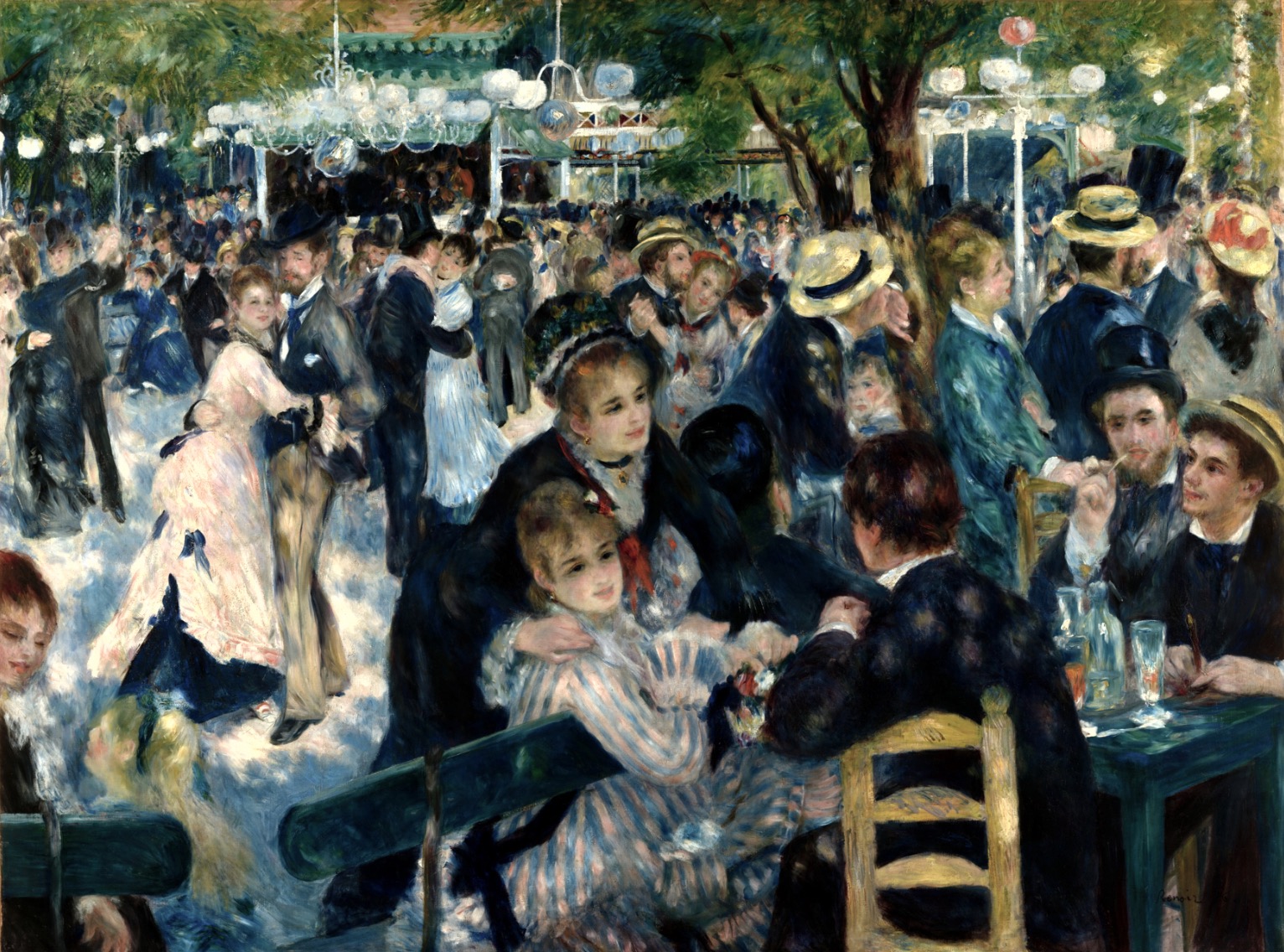
Bal du moulin de la Galette

“Bal du moulin de la Galette” by August Renoir

Nevertheless, the Moulin Rouge and Moulin de la Galette, are (or were, in their glory) located in Montmartre. If  someone mentions those names, somewhere in the back of my mind I conjure the memory of slides on a screen with vague colorful absinthe-blurred bar and club scenes by Henri de Toulouse-Lautrec, and Edgar Degas.  These are fairly accurate recollections. Renoir painted the festive, “Bal du moulin de la Galette” here. (Remember the men in their straw hats and the woman in the foreground in the blue and white striped dress?) And Degas painted “L’Absinthe” at café Nouvelle Athènes in the Place Pigalle at the foot of Montmartre in 1876. In the same year Vincent Van Gogh’s brother, Theo, brought him to Paris. Here he was neighbors with Georges Seurat and met Paul Gauguin, Lautrec, and others, and through their influence, and the influence of Paris scenes, his style became much more impressionistic.

"Windmills on Montmartre", 1886, Vincent van Gogh [Public domain], via Wikimedia Commons

“Windmills on Montmartre”, 1886, Vincent van Gogh [Public domain], via Wikimedia Commons

Van Gogh painted many images of Montmartre, Paris, and the windmill and surroundings of the Moulin de la Galette, (the tall windmill, you can still see, although you can’t get very close). Without his paintings, it’s hard to imagine the hills of that district with a quarry, open fields and gardens. From the clock window of the Musée D’Orsay you can make out Montmartre, and Sacre Couer at the top, and the hill appears, like much of Paris, to be covered with buildings. Which it essentially is.

🚇A brief aside: Usually at the Metro station there is someone of some official capacity in attendance, usually in some kind of a booth, and usually that FRENCH person is there to provide assistance to travelers. Despite the reputation that Parisians are by nature hostile to Americans, I found this to be largely untrue. Although the difference in languages can be an obstacle, usually by pointing at maps, images, and familiar geographic names, and the patience of these attendants, you will get to the information needed to board the right train. I was most impressed one morning when we were leaving Bercy and I was asking the attendant for help, as I pointed on the map to the tiny image of the Musée Marmottan Monet. At least, that’s what I thought I was pointing at, and thought I was saying in my feeble French. We slid the map back and forth across the counter a few times, and as he was tapping on a blur that I think was the Metro Station that he thought should be our destination, I said, “Excuse me”, unfolded my glasses and put them on. At the same time, he pushed my map back at me, with neither a word nor a grumble, pulled another from a rack, unfolded it, and flattened it out in front of us. I smiled. The scale of his map was about four times larger than mine, and soooo much easier to read. He quickly marked it, and confident then that I knew where to go, I said, “Merci!”

Still more to come…

— Christo

Montmartre: Yellow 9 to Green 12

🇫🇷 The Great France Art Tour of 2017

Basilica_Sacre_CoeurWe left the Musée Marmottan Monet fully sated and strolled with satisfaction along our previous route. It rained of course, but it was not an ugly downpour and that longest of Paris days was still young. The Muette Metro station was all tangled up with construction and pedestrian detours. Deb wanted to see Montmartre, and that was clearly our next destination. By Metro it was fairly straightforward, really, take Number 9 (yellow Metro) to some giant underground knot beneath Paris where many of the routes collided. Somewhere there we would switch to the Number 12 (dark green Metro) with the endpoint of Aubervilliers Front Populaire, whatever that is, (for us, meaning roughly “North”).

Subway travelers know the importance of these endpoints–they indicate which direction the train is going –and, just as may occur when you are flying down the freeway and take the wrong exit and end up somewhere else, somewhere you had no intention of being, a similar error in the subway will put you on the wrong platform taking the wrong train in the wrong direction. In which case, I say, “Remain calm,” and let that train go if you are not sure that it is the right one, another one should come along soon, unless it is late at night, and, you can always wait patiently, unless you have had a couple of beers and you have a full bladder, pressing, pressing you with the urgent need to empty it, on a quiet platform, well-lit, with no toilet, no obscuring panels, only a few straggling waiting families and a booth with a tired guard dutifully observing all the closed-circuit television monitors as he fiddles with a pistol in his holster, and all you can think about is the long countdown of 20 minutes until the next train arrives, 20 minutes to hold yourself, 20 minutes that never seems to be less than 20 minutes, and if you’re not thinking about the longest 20 minutes you have ever lived, then you think about how could you have chosen the wrong train and ended up way farther away from your hotel than you intended, and you have done so well on the Metro until now, why now, late at night, getting later, but still the same 20 minutes left!! How could this happen? Do the French names of the metro endpoints really all sound the same in the end?

But never mind that, we got off the dark green Number 12 on one of the several Montmartre stops.

A moment monsieur!” Let’s look at the word “Montmartre”. I don’t comprehend it all, but half of that name suggests a hill, a steep hill, a mont. So upon exiting the metro and following the signs in the narrow, tile arched tunnels we are warned several times in Anglais, no less, that to exit here, we had better be able to climb up the 67 steps. Or was it 167? Or 617? Whatever, it was a matter of climbing many upward steps to the exit. Eventually we popped out in the gentle rain onto the winding narrow cobble streets of Montmartre.

Can any “touristy” part of Paris be more touristy than Montmartre? I don’t know. Which is not to say it’s bad. It is old, it is windy, it is higher than the rest of the city. Every little street goes either higher or lower. If it travels on level ground for a time, don’t grow complacent, and don’t be surprised, that little road will soon go either up or down. And by the way, just because the roads are narrow, don’t expect them to be for pedestrians only. There is not a great amount of traffic, but watch for the trucks and vans and motorcycles! Now, continue up and eventually, above the faded red terra cotta rooflines, you catch a glimpse of the cathedral domes of Sacré Coeur, which is about as high as you can go. We arrived at the base of the main entrance, below a pair of wide steps. At the top of these vast staircases, a road circumnavigates the temple, bordered by a few wide sidewalks covered with throngs of tourists enjoying the expansive views of Paris offered from that height.

We were delighted to discover that our Metro passes enabled us to skip another climb and ride the funicular up the hillside. While we waited, I spent a few minutes trying to assist a Japanese gentleman who did not seem to comprehend that the funicular was not free, it required tickets and payment. With English, a word or two in French, and wishing I knew more Japanese, I said, “Hi!” (Yes!), and finally got him to go to the ticket booth to ask for assistance.

I guess Deb has seen enough of the gaudy gold glitz and bleeding Jesus interiors of churches that she did not want to see this one. Which was fine by me. At the top, after taking in the panorama, we circled around and down, reviewing the restaurants and brasseries, many of which were not yet open. I stopped for a selfie at Chez Plumeau, for obvious reasons, and then found an open window crêperie where I ordered a breakfast crepe to go.

BreakfastAnd so we wound our way down, tripping down the cobblestone, stopping now and then to peek in little shops and absorb the changing views. To Deb, I mentioned that the Moulin Rouge was in the vicinity, and which from my last visit seemed almost like a wax museum–unless you took in the live burlesque I guess. No need to see that. We tried not to look at any maps, hoping that we would sooner or later come upon a metro stop. And it was later, later and many steps down before we, that is, I, resorted to Google maps to be sure I was taking us in the right direction.

I didn’t know it then, but our little expedition to the heights and long journey downward foreshadowed similar adventures in Eze, and Vence, and finally in Nice, where we wandered down the back of the mountain into the old city, where the houses and restaurants were all pushed tightly together, and shaded and cooled in the hot afternoon by their own height and shadow and the shadow of the mountain.

More fun to come…

— Christo

A day it was, and what a day it was!

🇫🇷 The Great France Art Tour of 2017

It was the longest day in Paris, starting with a grand tour, followed by Monet’s Sunrise and so much more. What a joy it is to travel with an agreeable and flexible companion. That was my thought as Deb and I, now back at the Hotel Bercy, planned the remains of the day. It was a great plan! A magnificent plan! We were in Paris. How could it be anything less than a wonderful and successful plan?

"The Raft of the Medusa", by Eugene Gericault

“The Raft of the Medusa”, by Théodore Géricault

She had no great interest in the Louvre. Nor did I. A decade before, in my fifties, I had stumbled there upon the enormous and magnificent “Raft of the Medusa” by Théodore Géricault. I stood speechless, with tears embarrassingly welling in my eyes, a reaction inspired partly by the monumental size of the work, but more from its significance as a time portal, for I had stood at the same place, in the Louvre, forty years before that. In 1972, I had been overcome by waves of emotions: awe at the work, wonder at my fortune in being there seeing it, the loneliness of an adolescent far from home and family for the first time, experiencing something that ought to be, but due to circumstances, and the formidable magnificence of the art, could never be clearly communicated, much less shared, an experience condemned to always remain deeply and intensely personal. Thrust backward, then suddenly, flashing forward in time, instead of seeing more of what I wanted at the Louvre and processing that adolescent visit, instead, I spent way too much of that day dragged by an acquaintance through the endless sandstone monotony of Egyptian and Middle-Eastern architecture, of which I had in comparison to the Impressionists, no interest whatsoever.

MuseeDeOrsayThis time, I was in no hurry to enter the Louvre. If I were to pass through a time portal it would be at my choosing, and with opportunity to process the odyssey. Musée D’Orsay, was a possibility, although on yet another Paris trip, a redeeming one, alone, and only a few years before, I had made a thorough survey and with great satisfaction sought and found the Van Goghs, and so, even Orsay I could forego for something previously unseen, perhaps the gardens of Giverny? Or Musée Marmottan Monet?
MonetsGardenMercerville

Giverny replica, “Grounds for Sculpture”

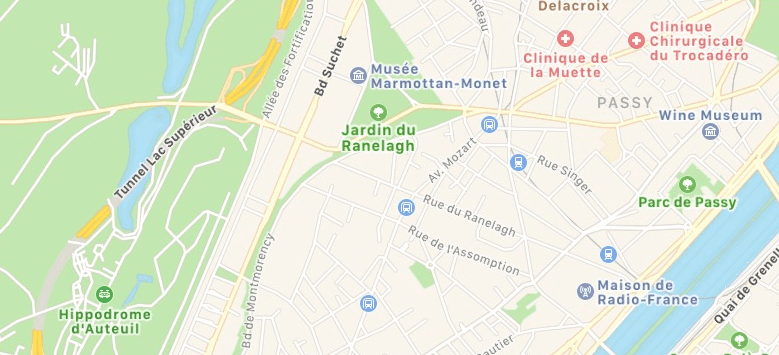
An uneventful 45 minute ride from Bercy discharged us from the train at the La Muette Metro station. We walked through a few typical urban Paris streets, then with the assistance of our paper tour map and Google Maps—for neither by itself seems sufficient until you can get them both to agree—we passed thru the Jardin Du Ranelagh—on the map, a small isolated green blotch before all the grey and white of Paris is surrounded on the western flank by the very green Bois de Boulogne – so very much green!

What is the “B-d-B”?? I don’t know. Don’t think I have ever been! It incorporates the Hippodrome de Autreil – which appears to be a horse track. Was this where Hemingway so smugly bet on horses, bragging about his successes, while living in supposed poverty on Hadley’s trust fund? And there on the map(s) in bold print is the A13, the route to the Chateau de Versailles. Is that the same as the Palace of Versailles? But I digress…

The Jardin was walkable in the overcast and humid late morning, slightly green, but suffering the trampled haggard look of excess foot traffic as only a city park can. Gravel walkways lined with green wooden-slatted benches. A few couples with long black umbrellas, more children with mothers nearby and nannies rolling the small ones in blue prams, and us stopping at the intersections of every odd-angled street, re-checking our orientation and looking for signs to the Musée.

It began to rain softly before we arrived at the steps to Marmottan, an unimposing old building of brick and faded white trim.

bdbinparis.pngThe Bois de Boulogne, as research has now revealed, is the second largest public park in Paris – bordering the west side of the 16th Arrondissement and containing not one, but two horse tracks. And yes, the Chateau de Versailles is in fact the one and same “Palace of Versailles” to us Americans. No, like the Louvre before it, and to the dismay and puzzlement of some, the Chateau de Versailles was rapidly discarded as a destination for “The Great Art Tour” – we had no interest. Been there, stood in line for hours, inside and out, and agreed with myself to never return. Never. Lavish, extravagant furnishings and homes of the royals and super-wealthy, past or present, do not do much for me, nor warrant a second visit.

WaterLilies

“Water Lilies” by Claude Monet

While we sidetrack the narrative with our decisions-not-to-see, a more difficult decision was the potential visit to Monet’s Giverny. The garden documented in books and film, and memorialized in uncountable blurry-until-viewed-from-the-proper-distance “Water Lilies” painted by the aged and near-blind Monsieur Claude. Definitely a place worthy of an Art Pilgrimage, but from our perspective requiring a Full Day traveling and touring outside of Paris with the strong potential for RAIN. We chose to hang closer to the City of Lights.

An excellent choice as it turns out. The next morning we learned that our traveling nemesis “Donald” and his long-suffering wife, hired a car with the aid of our excellent and very French guide, Christine, and we would likely have spent the day with them. From their anguished reports, it was a day mostly memorable for “Impressions of Rain and Mud” as opposed to Water Lilies.

What did we choose? As previously disclosed, a visit to Musée Marmottan Monet, which by chance included a selection of Sisley and Pissarro (among others) in addition to our target of “Impression: Sunrise”. And from there? Well, how about Montmartre? And the Latin Quarter? The Seine. And I have yet to get to the near disaster on the late night Metro.

Oh there is so much more. So much more. Such a long day. The longest day in Paris, with more to come.

…to be continued.

— Christo